Building history & listed status
History of Blumenhaus
An architectural gem in the Ofenstadt Velten.
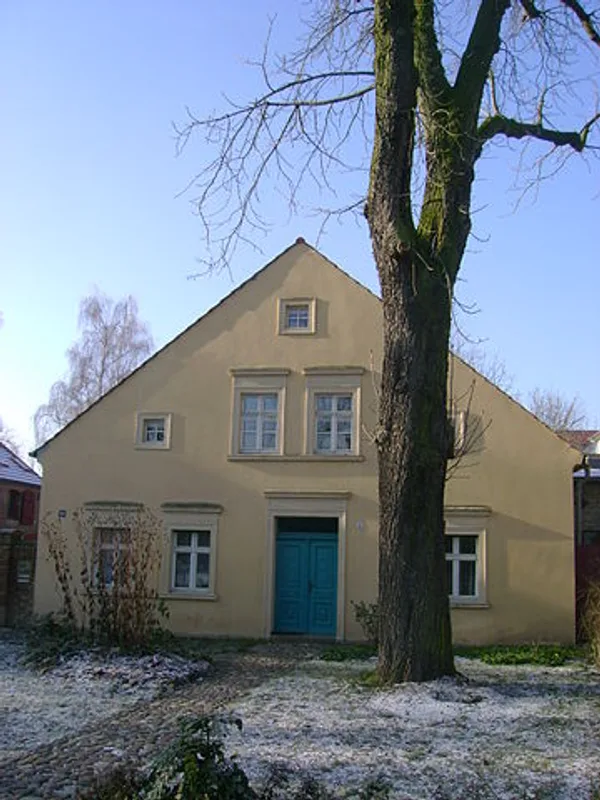
The listed Blumenhaus at Breite Straße 30 — a typical Märkisches Mittelflurhaus
The Märkisches Mittelflurhaus
Blumenhaus is a Märkisches Mittelflurhaus — the typical rural building type of Brandenburg from the 15th to the 19th century. Developed from the Lower Saxon hall house, this type shaped Brandenburg villages for centuries.
The building is gable-facing Breite Straße. This was typical for the cramped village structures of the Mark, where each farmstead had only a narrow street frontage.
The name "Mittelflurhaus" derives from the central hallway running the length of the building. Originally it led from the entrance door through the entire house: at the front the Stube — living and working room — in the middle the black kitchen with an open fireplace, and at the back utility rooms and a stable. This tripartite division of living, cooking and working under one roof was characteristic.
Building materials and development
The original construction consisted of clay stakes — a timber frame whose panels were filled with wickerwork of willow rods and clay daub. The roof was covered with reed or straw. Around 1800 fired bricks became established as a building material.
With the separation of agriculture around 1800, the stable and barn became separate buildings. The house became purely residential — a development Blumenhaus underwent.
The still-visible timber framework and the original wooden staircase inside bear witness to the craftsmanship of the 19th century.
Listed building status
Blumenhaus is a listed building — one of the few surviving Märkisches Mittelflurhäuser in the Velten area.
In addition to the external appearance, original interior details are also protected. Every renovation is carried out in consultation with the heritage authority.
For our guests this means: you are staying in a genuine, unadulterated piece of Brandenburg architectural history — not in a new build with a mock-timber look.
Your host
Gabriele Schellenberger
Gabriele Schellenberger lives at Blumenhaus and looks after the holiday apartments on site.
She is approachable for questions while respecting guests' privacy.
Contact details on the contact page.
Velten — the Ofenstadt
Velten, first mentioned in 1350, was a tranquil farming village until the Industrial Revolution. In 1835 the first tile-stove factory opened, and Velten became the world capital of tile-stove construction: 42 factories, over 2,000 employees, 100,000 stoves annually.
The famous Velten tile — with its characteristic white enamel glaze — became an export hit. From New York to Stockholm, tiled stoves from Velten could be found. 162 chimneys once defined the silhouette, and the title "Ofenstadt" was officially awarded in 2015.
Today, the Oven and Ceramics Museum, the Töppertour and the Hedwig Bollhagen Museum commemorate this history. All within a few minutes' walk from Blumenhaus.